“UMTHANDAZO” -by Thandi Ntuli
1
The title of Ava DuVernay’s extraordinary and galvanizing documentary 13TH refers to the 13th Amendment to the Constitution, which reads “Neither slavery nor involuntary servitude, except as a punishment for crime whereof the party shall have been duly convicted, shall exist within the United States.” The progression from that second qualifying clause to the horrors of mass criminalization and the sprawling American prison industry is laid out by DuVernay with bracing lucidity. With a potent mixture of archival footage and testimony from a dazzling array of activists, politicians, historians, and formerly incarcerated women and men, DuVernay creates a work of grand historical synthesis.
The 13th debuts on Netflix and in select theaters on 7 October, DuVernay, best known for directing 2014’s Oscar-nominated Selma, had kept the project a secret from the public during its production.
I’ve always loved Vincent van Gogh’s paintings. His psychedelic brush strokes instantly struck a cord with me the first time I encountered his work. Like countless others, I also believed I could relate to his struggles as an artist. I fell for the popular image—the iconic figure of the tortured artistic soul—which is no doubt a caricature of the man, a cartoon that has been (re)constructed and (re)presented to render him the poster boy for unrequited love, mental illness, and suicide. As I’ve matured I’ve learned to reject all such stereotypes as bullshit, no matter how romantically appealing they seem.
Several years ago I made a pilgrimage to the Van Gogh Museum in Amsterdam to encounter the man’s genius firsthand. Sadly, I departed somewhat underwhelmed by the experience. The magic eluded me. The impact of his artistry got subsumed in the space with so much of its focus on selling reproductions and memorabilia of all kinds—from umbrellas to coffee cups. I don’t expect any museum to be a cathedral of austerity. I recognize it takes funds to keep the doors open, but I felt this was a case where commercialism sucked all of the oxygen out of the exhibit.
My admiration for the artist, however, remains undiminished. Over two decades ago, inspired by his work, I wrote this poem. But that’s not what this is about. Below I have posted a trailer for an amazing new film that brings Van Gogh’s work to life. As you will see, it goes far beyond typical animation to achieve something extraordinary. I’m trying to wait patiently for the release in 2017.
The Kora Concerto was written during my time living in Nigeria. It is in three movements and is influenced by various musical traditions of West Africa as well as Rodrigo’s celebrated guitar concerto. It loosely follows the structure of that concerto with a medium-tempo first movement, slow second movement and lively up-tempo finale.
Somehow in this kora concerto I wanted to capture the musical worlds of West Africa and particularly the Kora whilst remaining true to the classical tradition in much the same way as Rodrigo was able to do with the Spanish folk influences in his concerto.
It is a fine balance to maintain integrity in two traditions at once and I hope this piece has managed to do this successfully. Creating a kora concerto that can also be played by a traditional kora player is something that I have wanted to do for many years.
Tunde Jegede – Kora soloist
Renu – tabla & congas
PSAPPHA ENSEMBLE
Conrad Marshall – flute
Rachael Clegg – oboe
Dov Goldberg – clarinet
Sarah Nixon – bassoon
Andrew Budden – French horn
Tracey Redfern – trumpet
Gemma Beeson – piano
Tim Williams – percussion
Benedict Holland – violin
Simon Gilks – violin
Rose Redgrave – viola
Jennifer Langridge – cello
James Manson – double bass
Tunde Jegede – Profile
Tunde Jegede is a composer and musician who has been steeped in the traditions of European and African classical music for the last 30 years.
His music has been performed all over the world in concert halls such as Carnegie Hall (New York), the Royal Albert Hall (London) and the Basilique (Paris) by international orchestras and artists including; the Royal Philharmonic Orchestra, the Philharmonia, the London Sinfonietta, the Brodsky Quartet, the Smith Quartet and by the percussion soloist, Evelyn Glennie.
Tunde is also a pioneer of African Classical Music and has a deep knowledge of traditional music and culture. As the founder of the African Classical Music Ensemble, Tunde has performed and recorded with some of Africa’s finest artists including Toumani Diabaté, Oumou Sangaré, Juldeh Camara, Bodé Lawal and the Pan African Orchestra .
From an early age, Tunde was uniquely schooled in both Western and African Classical Music. He attended the Purcell School of Music, UK’s first specialist music school conservatoire and also studied the music of the Kora (African Harp-Lute) and the Griot tradition under the Gambian Master of the Kora, Amadu Bansang Jobarteh, in a hereditary tradition that dates back over 700 years. From this unusual parallel education, Tunde gained a deep understanding and appreciation of both forms of music and their distinct legacies, and all these strands and influences have since informed his music and work as an instrumentalist, teacher, and international classical composer.
His music has since taken him all over the world and he has written three full-scale operas, twenty symphonic works and he has worked with over a hundred orchestras and chamber groups.
Tunde has recorded four solo albums including his seminal debut album, ‘Lamentation’ and ‘Still Moment’ a meditative album of solo Kora. His new solo kora and solo cello albums, ‘Heritage’ and ‘Testimony’ were both released in 2014. In that same year he was appointed Artistic Director of the MUSON (Musical Society of Nigeria) Centre and School of Music in Lagos, Nigeria where he is now based and has since established his own concert series, New Horizons.
The immensely talented Carolina Chocolate Drop, Leyla McCalla, takes us back to the future with her roots woman roots music.
Jazz sous les pommiers is an annual week-long jazz festival in Coutances, France.
I’ve been in Baltimore this week for a staged reading of “Shadowboxer,” an opera I co-wrote with composer Frank Proto. It was performed last night at the Carl J. Murphy Fine Arts Center at Morgan State University. Today (5/14) we move to the Peabody Institute in downtown Baltimore for a 7:30 performance, and a matinee performance on Sunday at 3:00 pm.
“Shadowboxer” was commissioned in 2007 by the Music School and Opera Studio of the University of Maryland, College Park. It premiered there in 2010 at the Clarice Smith Fine Arts Center. The three performances held this week mark the first time it has been done since its premiere. Carolyn Black-Sotir, who served as the assistant director for the original production, worked tirelessly to secure the funding needed to workshop the opera with a new ending, and arranged for it to become part of this year’s Play Lab Series at Center Stage in Baltimore.
Leon Major, who directed the original production, and Timothy Long who conducted it, returned to make the opera live again. I’ve included a few rehearsal shots below. To view excerpts from the original production at U. Maryland, click on this link to the “Shadowboxer” home page.
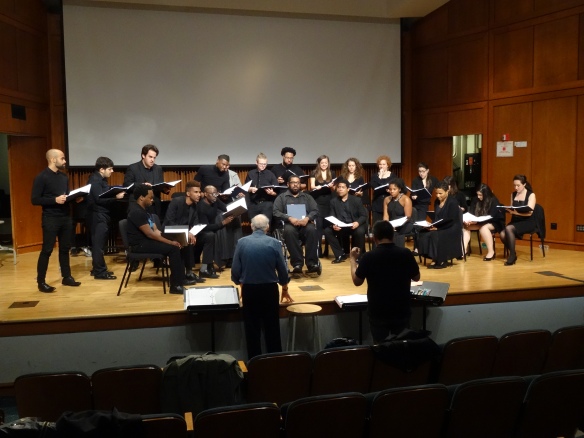
The Shadowboxer Ensemble
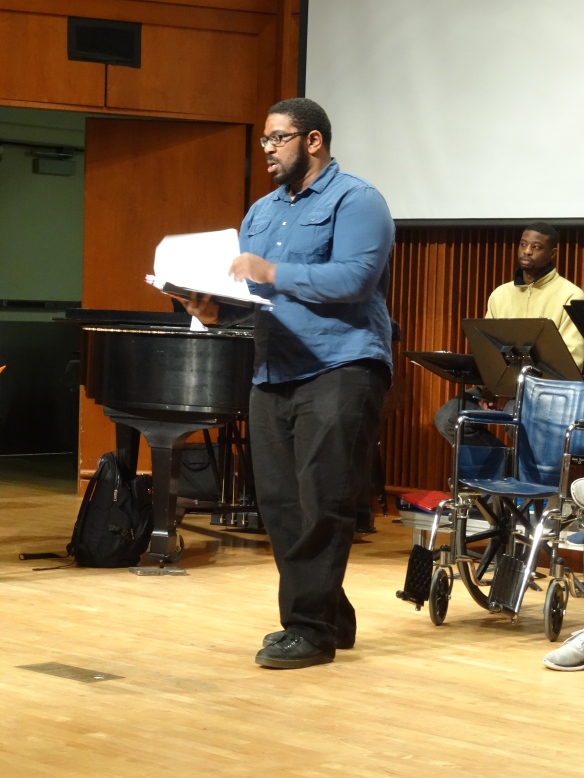
Old Joe -Performed by Daren Jackson

Marva Trotter Barrow (Joe’s first wife) performed by Lindsay Roberts, and Young Joe, performed by Terrence Chin-Loy
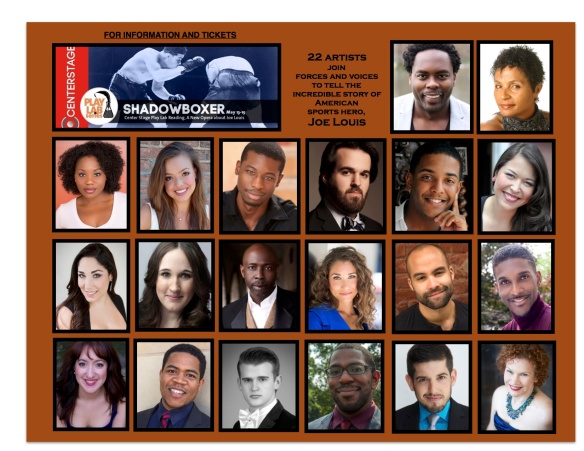
Shadowboxer Cast
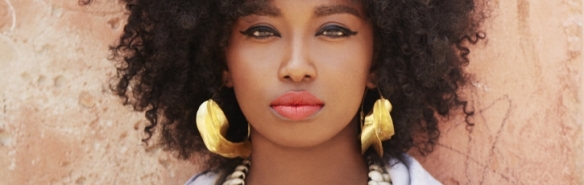
This video speaks to the devastating effects of war on women, and the spirit of resistance that emerges to confront such existential threats. It is the official video released by Inna Modja in 2015 to accompany the release of her album: Hotel Bamako.
Special thanks to Clyde T. who sent me the link from Panama.
Also from Hotel Bamako: Outlaw.
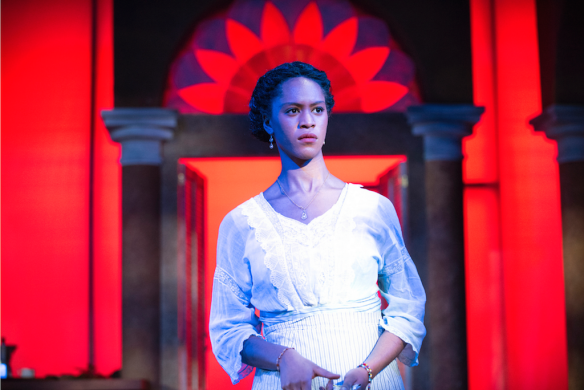
Bloodline Rumba, my new play, had a great premiere on its opening night (2/3/16) at the University of Louisville’s (UofL) Thrust Theatre. It is presented by the African American Theatre Program of the UofL Theatre Arts Department, and directed by the phenomenal Nefertiti Burton.
Sidney Edwards—who plays Sara Santos, a young Afro-Cuban woman seeking to attend medical school in NYC—is seen in the photo below. Her fellow cast members are: Shaleen Cholera (Ernesto), Paula G. Lockhart (Abuela), Casey Moulton (Dr. Ramos), Ross Shenkar (Senor Prado), and Danielle Smart (Lola).
The play runs until Monday (2/8/16). For performance times and ticket information, please click here.
To see more photos from the show, please click here. And here for photos by Aukram Burton.
To learn more about the production, check out this story in the Louisville Cardinal student newspaper.
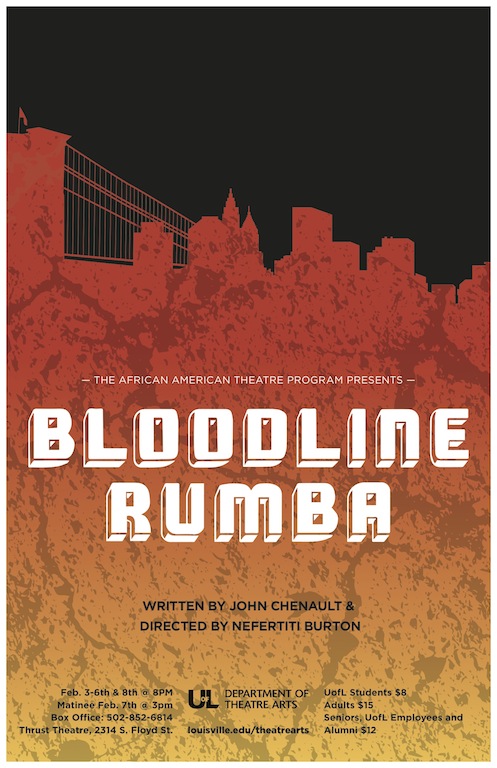
My new play, Bloodline Rumba, is premiering 8 pm Wednesday, February 3, at the University of Louisville (UofL). It is being produced by the African American Theatre Program of the UofL Theatre Arts Department, and directed by the brilliant Nefertiti Burton.
For more information, check out this story in the Louisville Courier-Journal.
 Ourstorian